The 10 best books on feedback, honestly reviewed
Ten books on giving, receiving and asking for feedback, each with a short honest review — what it's actually good for, and the one that argues feedback doesn't work.
On this page
The feedback shelf is enormous and a lot of it is the same book: a memorable acronym, a story about a manager called Dave, and three hundred pages of encouragement to be both kind and direct. The ten below are the ones that survived a harder test — did reading it change something we actually do? A few of them contradict each other, and one of them argues that the whole enterprise is mostly a waste of time. That one earned its place too.
No affiliate links here, no retailer links, nothing earned from any of these — read them in whatever order and from whatever library you like. What follows is what each one is good for, who should skip it, and where it falls down.
How we picked
Three filters, all aimed at the same reader: an individual manager, founder or senior specialist who has to run this themselves, without an HR department behind them.
- Does it survive contact with a real Tuesday? Frameworks that need a rollout, a platform or a training budget were cut.
- Does it say something the other nine don't? Overlap is heavy in this genre; near-duplicates lost to the earlier, better version.
- Is it honest about its own limits? Books that promise a technique will fix a relationship problem tend to make things worse.
The ten
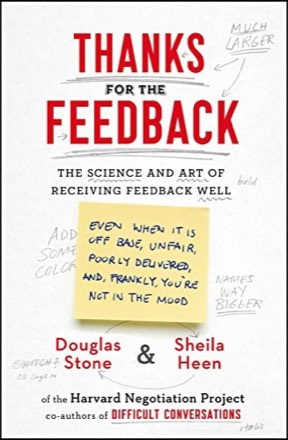
01Best for the defensiveness you can feel rising and can't stop
Thanks for the FeedbackThe Science and Art of Receiving Feedback Well
Douglas Stone & Sheila Heen · 2014
The only book here that treats receiving as the harder skill — and the one to read first.
Almost every other book on this list is written for the person talking. This one is written for the person being talked to, which is the position you're actually in when the information matters most. Its central move is a diagnostic: when feedback stings, work out which of three triggers fired — truth ("that's just wrong"), relationship ("coming from you?") or identity ("so I'm bad at this"). Naming the trigger buys you the few seconds you need not to argue.
The second idea is quieter and does more work: appreciation, coaching and evaluation are three different things, and half of all feedback conversations go wrong because one person is giving one and the other came for another. It's long, and the middle third repeats itself — skim it. But the diagnostic is the single most reusable thing on this shelf, and it pairs directly with what makes feedback survive a defensive reaction.

02Best for the gap between your self-image and your reputation
InsightWhy We're Not as Self-Aware as We Think
Tasha Eurich · 2017
The best account of why you can't see yourself — and why more introspection makes it worse.
Eurich's research programme produced the number this whole category runs on: about 95% of people believe they're self-aware, and something like 10–15% actually are. The book's useful distinction is between internal self-awareness (knowing your own values and reactions) and external (knowing how you land on others) — they're only loosely related, and most managers are stronger on the first while assuming it covers the second.
The counterintuitive chapter is on introspection: asking yourself why you did something reliably manufactures a plausible explanation rather than a true one, so she recommends what questions instead. Her practical answer to external self-awareness is a small set of "loving critics" — people who will tell you the truth and want you to do well. The business-book anecdotes are stretched thin in places, but the argument holds, and it's the intellectual backbone of why blind spots stay blind.
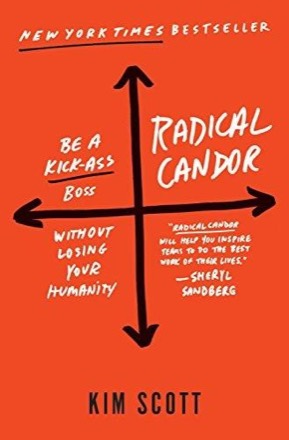
03Best for managers who go quiet because they're trying to be kind
Radical CandorBe a Kick-Ass Boss Without Losing Your Humanity
Kim Scott · 2017
A genuinely good two-axis idea, wrapped in a book that's mostly quoted by people who only read the axes.
Care personally on one axis, challenge directly on the other. The quadrant everyone remembers is obnoxious aggression; the one that describes most decent managers is ruinous empathy — withholding something true because saying it feels unkind, and letting someone walk into a much worse conversation six months later. Naming that pattern is worth the price of the book.
Two honest caveats. First, in practice the phrase gets used as a licence for bluntness while the "care personally" half — which takes months of showing up — is quietly skipped; Scott says so herself, and it keeps happening anyway. Second, it's written from a Google-and-Apple vantage point: big teams, deep benches, room to fail. If you run a team of six at a company nobody has heard of, translate before applying. Especially useful next to why the feedback sandwich stopped working, the technique it replaced — and worth reading against SBI, which does a completely different job.
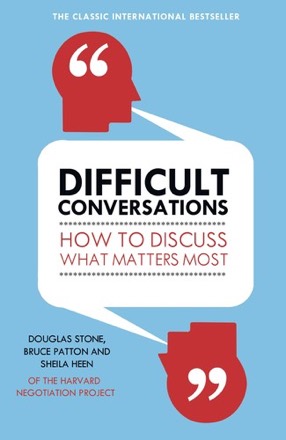
04Best for the conversation you've been rehearsing in the shower for a week
Difficult ConversationsHow to Discuss What Matters Most
Douglas Stone, Bruce Patton & Sheila Heen · 1999
The oldest book here and still the sharpest on what's actually happening in a hard conversation.
Out of the Harvard Negotiation Project, and it wears its age well because it's about the structure of disagreement rather than the fashions of workplace culture. The organising claim: under every difficult conversation run three others — what happened, how everyone feels about it, and what it says about who each person is. Most conversations fail because someone tries to settle all three at once, usually starting with the one that feels most like a verdict.
The move to steal is the shift from blame to contribution: instead of establishing whose fault it was, map what each person did that got you here. It changes the conversation from a trial into a repair job, and it's the honest version of what people mean when they say "no blame culture". Examples skew towards the domestic and the late-nineties, which dates the surface but not the argument.
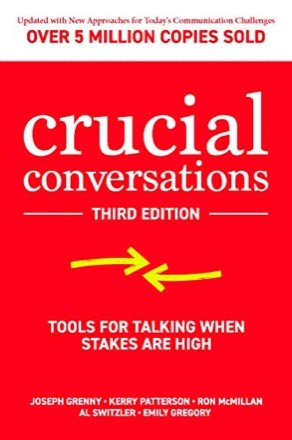
05Best for the moments where you go silent or go sharp
Crucial ConversationsTools for Talking When Stakes Are High
Joseph Grenny, Kerry Patterson, Ron McMillan, Al Switzler & Emily Gregory · 2021, 3rd edition
The most practical set of moves on this list, in the most exhausting corporate packaging.
The premise is that under pressure people default to silence or violence — withdrawing, or getting sharp — and that the variable worth watching mid-conversation isn't the content but whether the other person still feels safe enough to stay in it. Once you can spot safety draining out of a conversation, you can stop and rebuild it instead of pressing on into an argument nobody remembers accurately afterwards.
The concrete technique worth taking is contrasting: "I don't want you to think I'm questioning your judgement — I do want to sort out how the decision got made." It defuses the misreading before it hardens. Everything else comes wrapped in acronyms, workshop diagrams and examples that read like corporate training video scripts. Take the moves, leave the packaging, and don't feel obliged to finish it.
06Best for understanding why nobody tells you anything
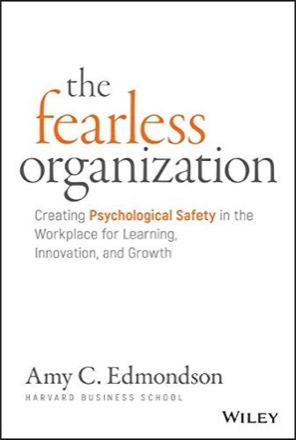
The Fearless OrganizationCreating Psychological Safety in the Workplace
Amy C. Edmondson · 2018
The research answer to 'my team says everything's fine' — and it turns out not to be about your team.
Edmondson's work reframes silence as rational. If speaking up has ever cost someone something — a cooler reception, a project quietly reassigned, a reputation for being difficult — then not speaking up is the sensible choice, and no amount of "my door is always open" changes that arithmetic. Psychological safety, in her account, is a measurable property of a team rather than a mood, and it predicts whether you ever hear about problems while they're still small.
She's careful about the two misreadings that dog the term: safety isn't niceness, and it isn't lowered standards — the high-performing case is high safety and high standards together. The book is more organisational than personal, so you'll find fewer scripts here than in the others. Read it for the diagnosis behind why people don't give you honest feedback, then get your tactics elsewhere.
07Best for pressure-testing everything else on this list
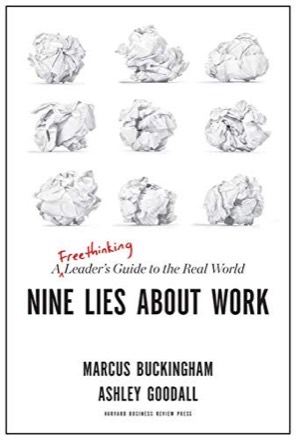
Nine Lies About WorkA Freethinking Leader's Guide to the Real World
Marcus Buckingham & Ashley Goodall · 2019
On the list precisely because it argues most feedback is worthless — and it's right about a third of the time.
Lie number seven is "people need feedback", and the argument behind it is the strongest challenge in this genre. Their case in Harvard Business Review rests on the idiosyncratic rater effect: when you rate another person on an abstract quality, most of the variance in your rating turns out to describe you, not them. Ratings of "strategic thinking" mostly measure what the rater means by strategic thinking. That's uncomfortable, and it's well evidenced.
Where they overreach is the leap from "ratings are noisy" to "so stop asking" — convenient for a book that sells a strengths-based alternative. Their own fix is closer to a correction than a rejection: report your reaction rather than issue an assessment, and describe moments rather than score traits. Which is exactly what the behavioural models do, and exactly why asking several people about specific behaviour beats asking one person to rate you on a quality.
08Best for turning feedback into a change other people actually notice
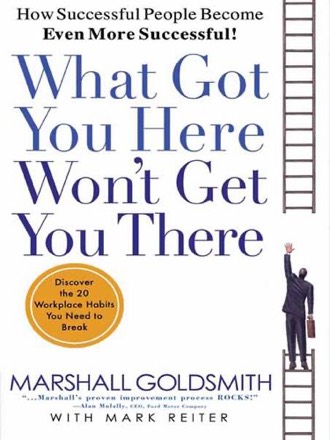
What Got You Here Won't Get You ThereHow Successful People Become Even More Successful
Marshall Goldsmith with Mark Reiter · 2007
Weak on getting at the truth, unbeaten on what to do the day after you have it.
The famous part is the list of twenty habits — winning too much, adding too much value, telling the world how smart you are — and it's a good list, in the sense that most readers wince at least twice. But the durable contribution is the follow-up mechanic that comes after the diagnosis: tell people specifically what you're working on, ask them monthly for one suggestion, and let the asking itself do half the work. Change other people notice is change you announced and then kept checking on.
It's also where feedforward comes from — asking for suggestions about the next attempt instead of judgements about the last one, which strips out most of the awkwardness for both sides. Goldsmith's executive-coaching register is heavy going, and the CEO anecdotes assume a level of seniority most readers don't have yet. The mechanic scales down anyway.
09Best for managers whose questions keep getting polite answers
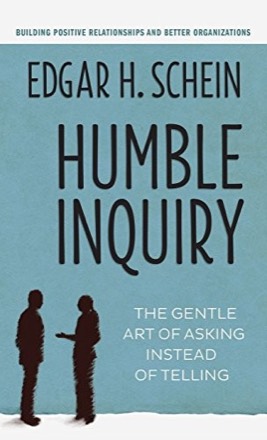
Humble InquiryThe Gentle Art of Asking Instead of Telling
Edgar H. Schein · 2013
A hundred pages on asking, and the shortest route to better answers on this list.
Schein's observation is that telling is the cultural default — status is awarded for having answers, not for needing them — and that seniority makes the pull towards telling stronger just as the cost of it rises. His alternative is a specific kind of asking: questions that come from genuine not-knowing, rather than the diagnostic ("have you considered…") or leading ("don't you think…") varieties that are really statements with a question mark attached.
It's short, closer to an essay than a manual, and light on scripts — if you want phrasing for specific situations you'll want a more practical guide to asking alongside it. What it gives you instead is an ear for the difference between a question that opens something and a question that closes it, which is most of the reason feedback conversations stall in the first two minutes.
10Best for your first year, when feedback is one of nine things you're bad at
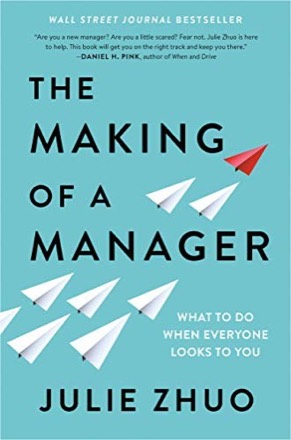
The Making of a ManagerWhat to Do When Everyone Looks to You
Julie Zhuo · 2019
Not really a feedback book — the best account of why feedback is so hard when everything else is new.
Zhuo became a manager at twenty-five and writes about it without the retrospective polish most management memoirs apply. The feedback chapters are good and unglamorous: give hard news early and in small pieces, be specific about what you saw, and accept that your first several attempts will be clumsy. What makes the book worth including is the surrounding context — feedback is genuinely harder when you're also learning hiring, prioritisation and how to run a meeting.
The caveat is the setting: fast-growing tech, big design org, a lot of structural support most readers won't have. Some of it transfers awkwardly to an eight-person company where you're also doing the work. Best read next to the mistakes that show up in a first management year, which is the same terrain from the other direction.
What's missing from this list, on purpose
There's a whole genre of "difficult people" books that sort colleagues into types — the bulldozer, the ghost, the martyr — and they're satisfying to read and useless the next morning, because the type tells you nothing about what to say. There's also a run of older classics built on the praise-criticism-praise structure that the research has since taken apart; if you want that argument, it's in one of our own pieces rather than another book.
And the more important omission is one none of these ten can fix. Every book here improves what you do with information — how to give it, take it, ask for it, or survive it. Not one of them can tell you what the people you work with already think and haven't said. That gap is not a reading problem — it's a question of running a round, and what that costs for one person turns out to be a much shorter answer than the shelf above.
Where Mirorly fits
Books hand you language. They can't hand you the sentence you have to say on Thursday, and that is the gap Mirorly is built for: the conversation you keep rehearsing and never having, prepared rather than improvised. It splits the work the way the work actually splits. For one thing that happened, you pick your situation out of a catalogue of forty-five and take the wording in one of three registers — opening with a question, opening with the point, or written down for the record — plus what to say when they deny it happened, bury you in explanation, or say nothing at all. For the note somebody asked you to write about a colleague, the wording was never the hard part: it's which two to four things are worth saying and in what order, and that is what gets checked.
Then there's the assumption the whole shelf quietly runs on — that someone will eventually tell you the truth about yourself unprompted, which is what Edmondson's research spends a book dismantling. Answering a set of questions about how you actually work is the version that needs nobody's participation but your own, and it's worth doing before you ask anyone else, because a gap only means something once you've written down what you expected to see. When you do want it from someone else, wording one request that doesn't come back as a compliment is where that starts.
Common questions
The one-line summary
Read Thanks for the Feedback first because receiving is the skill that compounds, Insight second because it explains why you can't see the thing you're being told, and treat Nine Lies About Work as the loyal opposition that keeps you asking about behaviour instead of collecting ratings; the rest are worth their pages for specific jobs — hard conversations, high-stakes moments, silent teams, first years — but none of them, however good, can tell you what the people around you already think and haven't said.